


Page 3 - Reproduction in Animals
P. 3
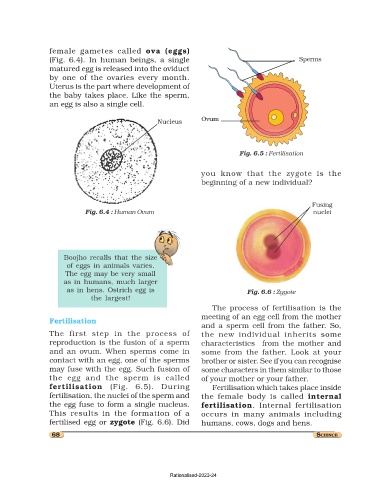
female gametes called ova (eggs)
                 (Fig. 6.4). In human beings, a single                                            Sperms
                 matured egg is released into the oviduct
                 by one of the ovaries every month.
                 Uterus is the part where development of
                 the baby takes place. Like the sperm,
                 an egg is also a single cell.

                                                                   Ovum
                                                    Nucleus


                                                                               Fig. 6.5 : Fertilisation


                                                                   you know that the zygote is the
                                                                   beginning of a new individual?


                                                                                                       Fusing
                             Fig. 6.4 : Human Ovum                                                     nuclei


                      Boojho recalls that the size
                       of eggs in animals varies.
                      The egg may be very small
                      as in humans, much larger
                       as in hens. Ostrich egg is                                Fig. 6.6 : Zygote
                               the largest!
                                                                      The process of fertilisation is the
                                                                   meeting of an egg cell from the mother
                 Fertilisation
                                                                   and a sperm cell from the father. So,
                 The first step in the process of                  the new individual inherits some
                 reproduction is the fusion of a sperm             characteristics    from the mother and
                 and an ovum. When sperms come in                  some from the father. Look at your
                 contact with an egg, one of the sperms            brother or sister. See if you can recognise
                 may fuse with the egg. Such fusion of             some characters in them similar to those
                 the egg and the sperm is called                   of your mother or your father.
                 fertilisation       (Fig. 6.5). During               Fertilisation which takes place inside
                 fertilisation, the nuclei of the sperm and        the female body is called internal
                 the egg fuse to form a single nucleus.            fertilisation. Internal fertilisation
                 This results in the formation of a                occurs in many animals including
                 fertilised egg or zygote     (Fig. 6.6). Did      humans, cows, dogs and hens.
                  68                                                                                    SCIENCE


                                                        Rationalised-2023-24

