


Page 5 - Reproduction in Animals
P. 5
How could a single cell
                              Though these animals lay                     become such a big
                         hundreds of eggs and release                          individual?
                        millions of sperms, all the eggs
                        do not get fertilised and develop          Development of Embryo
                              into new individuals.
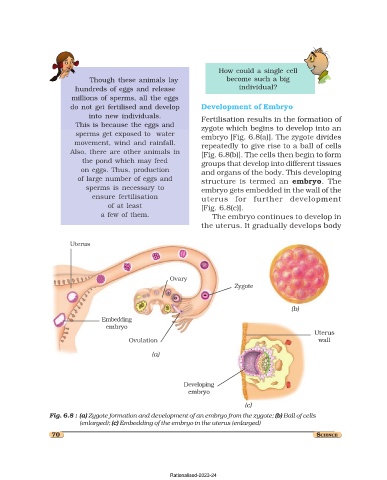
                                                                   Fertilisation results in the formation of
                          This is because the eggs and
                                                                   zygote which begins to develop into an
                          sperms get exposed to     water
                                                                   embryo [Fig. 6.8(a)]. The zygote divides
                         movement, wind and rainfall.
                                                                   repeatedly to give rise to a ball of cells
                        Also, there are other animals in
                                                                   [Fig. 6.8(b)]. The cells then begin to form
                            the pond which may feed
                                                                   groups that develop into different tissues
                           on eggs. Thus, production               and organs of the body. This developing
                          of large number of eggs and
                                                                   structure is termed an embryo. The
                             sperms is necessary to                embryo gets embedded in the wall of the
                               ensure fertilisation
                                                                   uterus for further development
                                    of at least                    [Fig. 6.8(c)].
                                  a few of them.                      The embryo continues to develop in
                                                                   the uterus. It gradually develops body


                        Uterus


                                                        Ovary
                                                                             Zygote


                                                                                                (b)
                                  Embedding
                                    embryo
                                                                                                       Uterus
                                           Ovulation                                                     wall

                                                  (a)


                                                             Developing
                                                              embryo
                                                                                 (c)
                 Fig. 6.8 : (a) Zygote formation and development of an embryo from the zygote; (b) Ball of cells
                           (enlarged); (c) Embedding of the embryo in the uterus (enlarged)
                  70                                                                                    SCIENCE


                                                        Rationalised-2023-24

