


Page 8 - Reproduction in Animals
P. 8
Activity 6.3

                  Get permanent slides of
                  hydra.  Observe them using
                  hand lens or a microscope.
                  Look out for any bulges
                  from the parent body.
                  Count the number of
                  bulges that you see in
                  different slides. Also, note
                  the size of the bulges. Draw
                  the diagram of hydra, as
                  you see it. Compare it with
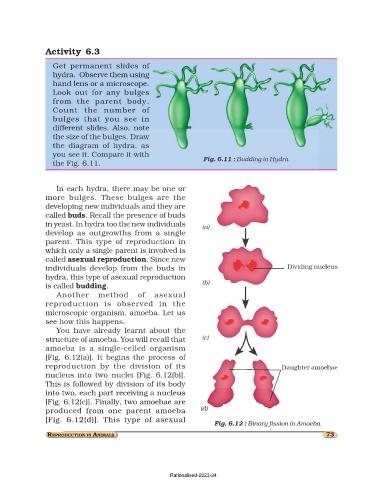
                                                                   Fig. 6.11 : Budding in Hydra
                  the Fig. 6.11.


                   In each hydra, there may be one         or
                more    bulges. These bulges are the
                developing new individuals and they are
                called buds. Recall the presence of buds
                in yeast. In hydra too the new individuals
                                                                   (a)
                develop as outgrowths from a single
                parent. This type of reproduction in
                which only a single parent is involved is
                called asexual reproduction. Since new
                individuals develop from the buds in                                           Dividing nucleus
                hydra, this type of asexual reproduction
                                                                   (b)
                is called budding.
                   Another       method       of   asexual
                reproduction is observed in the
                microscopic organism, amoeba. Let us
                see how this happens.
                   You have already learnt about the
                structure of amoeba. You will recall that          (c)
                amoeba is a single-celled organism
                [Fig. 6.12(a)]. It begins the process of
                reproduction by the division of its                                          Daughter amoebae
                nucleus into two nuclei [Fig. 6.12(b)].
                This is followed by division of its body
                into two, each part receiving a nucleus
                [Fig. 6.12(c)]. Finally, two amoebae are
                produced from one parent amoeba                   (d)
                [Fig. 6.12(d)]. This type of asexual
                                                                       Fig. 6.12 : Binary fission in Amoeba

                REPRODUCTION IN ANIMALS                                                                    73


                                                        Rationalised-2023-24

