


Page 4 - Reproduction in Animals
P. 4
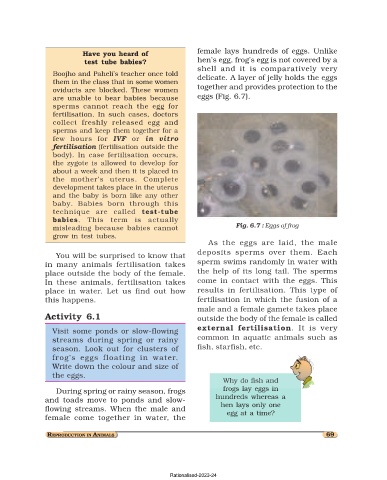
female lays hundreds of eggs. Unlike
                            Have you heard of
                             test tube babies?                   hen’s egg, frog’s egg is not covered by a
                                                                 shell and it is comparatively very
                  Boojho and Paheli’s teacher once told          delicate. A layer of jelly holds the eggs
                  them in the class that in some women
                  oviducts are blocked. These women              together and provides protection to the
                  are unable to bear babies because              eggs (Fig. 6.7).
                  sperms cannot reach the egg for
                  fertilisation. In such cases, doctors
                  collect freshly released egg and
                  sperms and keep them together for a
                  few hours for IVF or          in vitro
                  fertilisation (fertilisation outside the
                  body). In case fertilisation occurs,
                  the zygote is allowed to develop for
                  about a week and then it is placed in
                  the mother’s uterus. Complete
                  development takes place in the uterus
                  and the baby is born like any other
                  baby. Babies born through this
                  technique are called test-tube
                  babies. This term is actually
                  misleading because babies cannot                            Fig. 6.7 : Eggs of frog
                  grow in test tubes.
                                                                     As the eggs are laid, the male
                                                                 deposits sperms over them. Each
                   You will be surprised to know that
                in many animals fertilisation takes              sperm swims randomly in water with
                place outside the body of the female.            the help of its long tail. The sperms
                In these animals, fertilisation takes            come in contact with the eggs. This
                place in water. Let us find out how              results in fertilisation. This type of
                this happens.                                    fertilisation in which the fusion of a
                                                                 male and a female gamete takes place
                Activity 6.1                                     outside the body of the female is called
                                                                 external fertilisation. It is very
                  Visit some ponds or slow-flowing
                  streams during spring or rainy                 common in aquatic animals such as
                  season. Look out for clusters of               fish, starfish, etc.
                  frog’s   eggs    floating    in  water.
                  Write down the colour and size of
                  the eggs.
                                                                          Why do fish and
                   During spring or rainy season, frogs                   frogs lay eggs in
                                                                       hundreds whereas a
                and toads move to ponds and slow-
                                                                         hen lays only one
                flowing streams. When the male and                         egg at a time?
                female come together in water, the


                REPRODUCTION IN ANIMALS                                                                    69


                                                        Rationalised-2023-24

