


Page 4 - Sources of Energy
P. 4
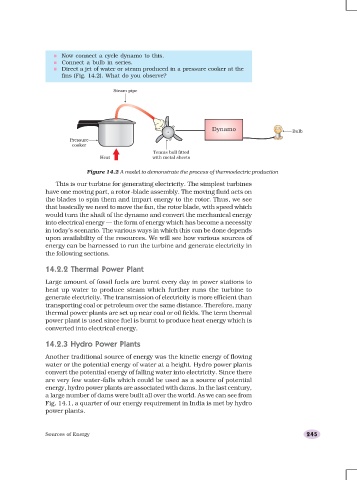
Now connect a cycle dynamo to this.
Connect a bulb in series.
Direct a jet of water or steam produced in a pressure cooker at the
fins (Fig. 14.2). What do you observe?
Figure 14.2 A model to demonstrate the process of thermoelectric production
This is our turbine for generating electricity. The simplest turbines
have one moving part, a rotor-blade assembly. The moving fluid acts on
the blades to spin them and impart energy to the rotor. Thus, we see
that basically we need to move the fan, the rotor blade, with speed which
would turn the shaft of the dynamo and convert the mechanical energy
into electrical energy — the form of energy which has become a necessity
in today’s scenario. The various ways in which this can be done depends
upon availability of the resources. We will see how various sources of
energy can be harnessed to run the turbine and generate electricity in
the following sections.
14.2.2 Thermal Power Plant
Large amount of fossil fuels are burnt every day in power stations to
heat up water to produce steam which further runs the turbine to
generate electricity. The transmission of electricity is more efficient than
transporting coal or petroleum over the same distance. Therefore, many
thermal power plants are set up near coal or oil fields. The term thermal
power plant is used since fuel is burnt to produce heat energy which is
converted into electrical energy.
14.2.3 Hydro Power Plants
Another traditional source of energy was the kinetic energy of flowing
water or the potential energy of water at a height. Hydro power plants
convert the potential energy of falling water into electricity. Since there
are very few water-falls which could be used as a source of potential
energy, hydro power plants are associated with dams. In the last century,
a large number of dams were built all over the world. As we can see from
Fig. 14.1, a quarter of our energy requirement in India is met by hydro
power plants.
Sources of Energy 245

