


Page 9 - Sources of Energy
P. 9
Design and build a solar cooker or water-heater using low-cost
material available and check what temperatures are achieved in
your system.
Discuss what would be the advantages and limitations of using
the solar cooker or water-heater.
It is easy to see that these devices are useful only at certain times
during the day. This limitation of using solar energy is overcome by
using solar cells that convert solar energy into electricity. A typical cell
develops a voltage of 0.5–1 V and can produce about 0.7 W of electricity
when exposed to the Sun. A large number of solar cells are, combined
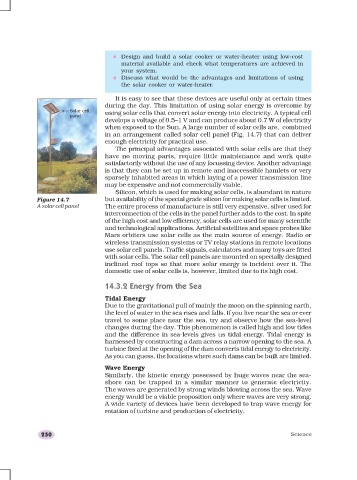
in an arrangement called solar cell panel (Fig. 14.7) that can deliver
enough electricity for practical use.
The principal advantages associated with solar cells are that they
have no moving parts, require little maintenance and work quite
satisfactorily without the use of any focussing device. Another advantage
is that they can be set up in remote and inaccessible hamlets or very
sparsely inhabited areas in which laying of a power transmission line
may be expensive and not commercially viable.
Silicon, which is used for making solar cells, is abundant in nature
Figure 14.7 but availability of the special grade silicon for making solar cells is limited.
A solar cell panel The entire process of manufacture is still very expensive, silver used for
interconnection of the cells in the panel further adds to the cost. In spite
of the high cost and low efficiency, solar cells are used for many scientific
and technological applications. Artificial satellites and space probes like
Mars orbiters use solar cells as the main source of energy. Radio or
wireless transmission systems or TV relay stations in remote locations
use solar cell panels. Traffic signals, calculators and many toys are fitted
with solar cells. The solar cell panels are mounted on specially designed
inclined roof tops so that more solar energy is incident over it. The
domestic use of solar cells is, however, limited due to its high cost.
14.3.2 Energy from the Sea
Tidal Energy
Due to the gravitational pull of mainly the moon on the spinning earth,
the level of water in the sea rises and falls. If you live near the sea or ever
travel to some place near the sea, try and observe how the sea-level
changes during the day. This phenomenon is called high and low tides
and the difference in sea-levels gives us tidal energy. Tidal energy is
harnessed by constructing a dam across a narrow opening to the sea. A
turbine fixed at the opening of the dam converts tidal energy to electricity.
As you can guess, the locations where such dams can be built are limited.
Wave Energy
Similarly, the kinetic energy possessed by huge waves near the sea-
shore can be trapped in a similar manner to generate electricity.
The waves are generated by strong winds blowing across the sea. Wave
energy would be a viable proposition only where waves are very strong.
A wide variety of devices have been developed to trap wave energy for
rotation of turbine and production of electricity.
250 Science

