


Page 5 - Sources of Energy
P. 5
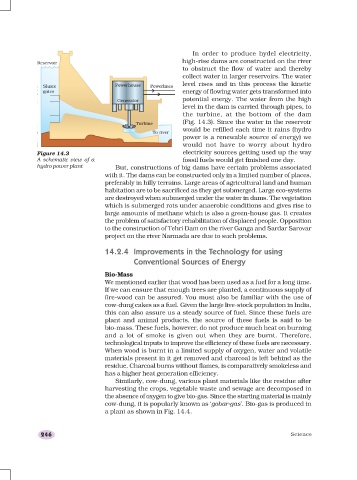
In order to produce hydel electricity,
                                                               high-rise dams are constructed on the river
                                                                to obstruct the flow of water and thereby
                                                                collect water in larger reservoirs. The water
                                                                level rises and in this process the kinetic
                                                                energy of flowing water gets transformed into
                                                                potential energy. The water from the high
                                                                level in the dam is carried through pipes, to
                                                                the turbine, at the bottom of the dam
                                                                (Fig. 14.3). Since the water in the reservoir
                                                                would be refilled each time it rains (hydro
                                                                power is a renewable source of energy) we
                                                                would not have to worry about hydro
              Figure 14.3                                       electricity sources getting used up the way
              A schematic view of a                             fossil fuels would get finished one day.
              hydro power plant          But, constructions of big dams have certain problems associated
                                     with it. The dams can be constructed only in a limited number of places,
                                     preferably in hilly terrains. Large areas of agricultural land and human
                                     habitation are to be sacrificed as they get submerged. Large eco-systems
                                     are destroyed when submerged under the water in dams. The vegetation
                                     which is submerged rots under anaerobic conditions and gives rise to
                                     large amounts of methane which is also a green-house gas. It creates
                                     the problem of satisfactory rehabilitation of displaced people. Opposition
                                     to the construction of Tehri Dam on the river Ganga and Sardar Sarovar
                                     project on the river Narmada are due to such problems.

                                     14.2.4 Improvements in the Technology for using
                                               Conventional Sources of Energy

                                     Bio-Mass
                                     We mentioned earlier that wood has been used as a fuel for a long time.
                                     If we can ensure that enough trees are planted, a continuous supply of
                                     fire-wood can be assured. You must also be familiar with the use of
                                     cow-dung cakes as a fuel. Given the large live-stock population in India,
                                     this can also assure us a steady source of fuel. Since these fuels are
                                     plant and animal products, the source of these fuels is said to be
                                     bio-mass. These fuels, however, do not produce much heat on burning
                                     and a lot of smoke is given out when they are burnt. Therefore,
                                     technological inputs to improve the efficiency of these fuels are necessary.
                                     When wood is burnt in a limited supply of oxygen, water and volatile
                                     materials present in it get removed and charcoal is left behind as the
                                     residue. Charcoal burns without flames, is comparatively smokeless and
                                     has a higher heat generation efficiency.
                                         Similarly, cow-dung, various plant materials like the residue after
                                     harvesting the crops, vegetable waste and sewage are decomposed in
                                     the absence of oxygen to give bio-gas. Since the starting material is mainly
                                     cow-dung, it is popularly known as ‘gobar-gas’. Bio-gas is produced in
                                     a plant as shown in Fig. 14.4.


               246                                                                                   Science

