


Page 6 - Sources of Energy
P. 6
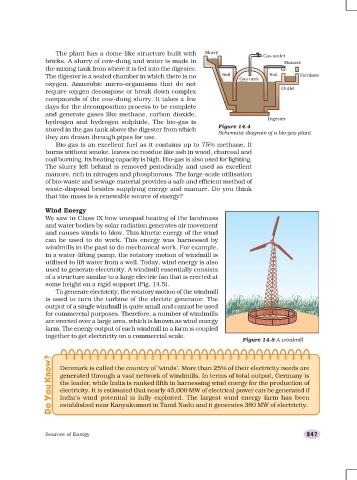
The plant has a dome-like structure built with
                 bricks. A slurry of cow-dung and water is made in
                 the mixing tank from where it is fed into the digester.
                 The digester is a sealed chamber in which there is no
                 oxygen. Anaerobic micro-organisms that do not
                 require oxygen decompose or break down complex
                 compounds of the cow-dung slurry. It takes a few
                 days for the decomposition process to be complete
                 and generate gases like methane, carbon dioxide,
                 hydrogen and hydrogen sulphide. The bio-gas is
                                                                            Figure 14.4
                 stored in the gas tank above the digester from which
                                                                            Schematic diagram of a bio-gas plant
                 they are drawn through pipes for use.
                    Bio-gas is an excellent fuel as it contains up to 75% methane. It
                 burns without smoke, leaves no residue like ash in wood, charcoal and
                 coal burning. Its heating capacity is high. Bio-gas is also used for lighting.
                 The slurry left behind is removed periodically and used as excellent
                 manure, rich in nitrogen and phosphorous. The large-scale utilisation
                 of bio-waste and sewage material provides a safe and efficient method of
                 waste-disposal besides supplying energy and manure. Do you think
                 that bio-mass is a renewable source of energy?

                 Wind Energy
                 We saw in Class IX how unequal heating of the landmass
                 and water bodies by solar radiation generates air movement
                 and causes winds to blow. This kinetic energy of the wind
                 can be used to do work. This energy was harnessed by
                 windmills in the past to do mechanical work. For example,
                 in a water-lifting pump, the rotatory motion of windmill is
                 utilised to lift water from a well. Today, wind energy is also
                 used to generate electricity. A windmill essentially consists
                 of a structure similar to a large electric fan that is erected at
                 some height on a rigid support (Fig. 14.5).
                    To generate electricity, the rotatory motion of the windmill
                 is used to turn the turbine of the electric generator. The
                 output of a single windmill is quite small and cannot be used
                 for commercial purposes. Therefore, a number of windmills
                 are erected over a large area, which is known as wind energy
                 farm. The energy output of each windmill in a farm is coupled
                 together to get electricity on a commercial scale.
                                                                                    Figure 14.5 A windmill


                  Do You Know?  Denmark is called the country of ‘winds’. More than 25% of their electricity needs are


                      generated through a vast network of windmills. In terms of total output, Germany is
                      the leader, while India is ranked fifth in harnessing wind energy for the production of
                      electricity. It is estimated that nearly 45,000 MW of electrical power can be generated if
                      India’s wind potential is fully exploited. The largest wind energy farm has been
                      established near Kanyakumari in Tamil Nadu and it generates 380 MW of electricity.


                 Sources of Energy                                                                        247

