


Page 8 - Sources of Energy
P. 8
14.3.1 Solar Energy
The Sun has been radiating an enormous amount of energy at the present
rate for nearly 5 billion years and will continue radiating at that rate for
about 5 billion years more. Only a small part of solar energy reaches the
outer layer of the earth’s atmosphere. Nearly half of it is absorbed while
passing through the atmosphere and the rest reaches the earth’s surface.
Do You Know? India is lucky to receive solar energy for greater part of the year. It is estimated that
during a year India receives the energy equivalent to more than 5,000 trillion kWh.
2
Under clear (cloudless) sky conditions, the daily average varies from 4 to 7 kWh/m .
The solar energy reaching unit area at outer edge of the earth’s atmosphere exposed
perpendicularly to the rays of the Sun at the average distance between the Sun and
earth is known as the solar constant. It is estimated to be approximately 1.4 kJ per
second per square metre or 1.4 kW/m .
Activity 14.5
Activity 14.5 2
Activity 14.5
Activity 14.5
Activity 14.5
Take two conical flasks and paint one white and the other black. Fill
both with water.
Place the conical flasks in direct sunlight for half an hour to one
hour.
Touch the conical flasks. Which one is hotter? You could also
measure the temperature of the water in the two conical flasks
with a thermometer.
Can you think of ways in which this finding could be used in your
daily life?
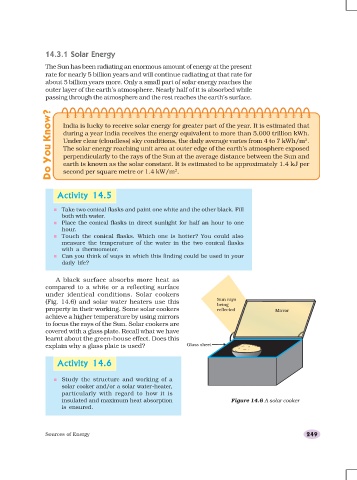
A black surface absorbs more heat as
compared to a white or a reflecting surface
under identical conditions. Solar cookers
(Fig. 14.6) and solar water heaters use this
property in their working. Some solar cookers
achieve a higher temperature by using mirrors
to focus the rays of the Sun. Solar cookers are
covered with a glass plate. Recall what we have
learnt about the green-house effect. Does this
explain why a glass plate is used?
Activity 14.6
Activity 14.6
Activity 14.6
Activity 14.6
Activity 14.6
Study the structure and working of a
solar cooker and/or a solar water-heater,
particularly with regard to how it is
insulated and maximum heat absorption Figure 14.6 A solar cooker
is ensured.
Sources of Energy 249

